Tara Rajkumar
The Art of Expression
A journey through classical traditions, the language of the artist, and a lineage of teachers.
01 — Mohiniyattam
The dance of the enchantress
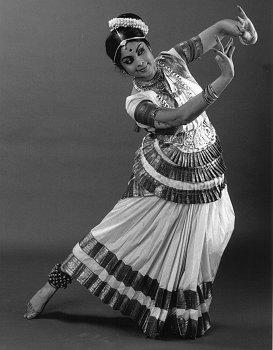
Mohiniyattam is Kerala’s lasya form: circular paths, a soft sway through the torso, and eyes that finish a sentence the hands have only begun. The costume is white and gold. The hair is gathered into a bun. The music belongs to the sopana tradition, closer to the temple step than to the concert stage.
She learned it from Kalamandalam Kalyanikutty Amma, when the repertoire was still short. In those years the costume often hid a dancer’s feet. Rajkumar kept hers visible. Footwork that cannot be seen cannot be judged, and she wanted it judged. The later bun, the konda, gave the form a Kerala silhouette of its own.
A student begins with namaskaram, then footwork, body exercises, and training of the eyes. Facial expression and the gestural language of the Hastalakshana Deepika come next. The course she described runs for about six years: cholkettu, jatiswaram, a padavarnam, Ramashabdam, padams, a major composition, the Dashavatara, and thillana, with her own choreography set around that spine.
02 — Kathakali
Stories painted on the face
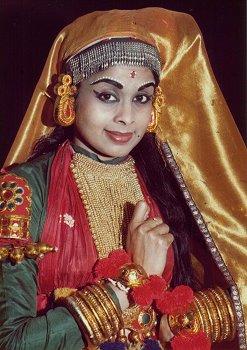
Kathakali is dance-drama: a codified glance, a face built in pigment, and stories that can occupy an evening. She began it as a child and was trusted, very young, with the role of Krishna beside Kalamandalam Krishnan Nair. Later she danced both women and men, including Mathangi in Chandalika and Mary Magdalene, a role she was the first to give a Kathakali body.
In class she kept the order her gurus used. The prayer, kalsadhakam for the feet, meyyadakkam and chuzhippu for the body, kannusadhakam for the eyes, then abhinaya. Nothing ornamental is added before the instrument of the body is awake.
In Melbourne, Sundays at Mangala Studios in Carlton held several batches of students. Through the week she taught at her home studio in Dingley. On Tuesdays she taught Kathakali at Erasmus School in Hawthorn, and from that teaching came a Ramayana danced by the whole school. The schedule is hers as she described it in 2009. The principle has not dated: classical form is taught slowly, in person, and then trusted to travel.
The teachers
Kathakali(Kochi)
Moleri Namboothiri
She took her serious Kathakali training with him in Kochi.
Kathakali(advanced)
Kalamandalam Krishnan Nair
Among the great Kathakali actors of the century. She danced Krishna opposite him.
Kathakali(Delhi)
Punnathoor Madhava Panicker
Principal of the International Centre for Kathakali. He choreographed her Mary Magdalene.
Mohiniyattam(Kochi)
Kalamandalam Kalyanikutty Amma
The guru who revived Mohiniyattam, Kerala’s swaying dance of the enchantress.
Abhinaya
Mani Madhava Chakyar
A master of Koodiyattam, famed for the expressive power of his eyes.
Odissi(Delhi, 1968–71)
Surendra Nath Jena
The sculptural temple dance of Odisha. She studied it, then returned her attention to Kathakali and Mohiniyattam.
The tradition continues